How to Make Money Blogging: 7 Realistic Ways to Monetize a Blog
If you’re wondering how to make money blogging, you’ve probably run into two very different stories online. One says blogging is dead. The other says you can make thousands of dollars a month in your sleep. Neither one tells the whole truth.
A blog can absolutely become an income-producing asset. But it usually doesn’t happen because you publish a few articles, drop in some affiliate links, and wait for money to appear.
The real process looks more like useful content leading to traffic, traffic leading to trust, trust leading to monetization, and monetization getting refined over time. That’s the model I’ve been using while building SmileGrows, not as a quick-money experiment, but as a content library where I’m learning what people actually search for, connecting related articles, and gradually layering in monetization where it genuinely makes sense.
So if you’re asking how bloggers actually make money, let’s go through the seven models I think beginners should understand before picking one.

1. Affiliate Marketing
Affiliate marketing is probably the easiest model to wrap your head around. You recommend a product or service, someone clicks your unique link, and if they make a qualifying purchase, you may earn a commission.
Picture an article like “The Best Tools I Use to Build a Blog”, inside it, you could naturally recommend hosting, SEO software, or email marketing tools that genuinely fit what the reader is trying to do.
The important part is sequencing: the article should solve a real problem first, and the affiliate link comes second, almost as a natural extension of the answer rather than the point of the article. I’ve already built out a full Affiliate Marketing section on SmileGrows, because there’s genuinely more to this model than sticking a few links into a post.
[What Is Affiliate Marketing? A Beginner’s Guide to Building Passive Income Online]
If you’re completely new to the concept, that’s where I’d start, and you can continue from there into:
[How to Become an Affiliate Marketer in 2026: A Step-by-Step Guide]
[How to Start Affiliate Marketing With No Audience]
The advantage here is you don’t need to create your own product. The disadvantage is you need traffic and trust before it means anything, a site with ten visitors a month isn’t going to generate meaningful affiliate income no matter how many links you sprinkle in.
2. Display Advertising
The second common model is display advertising, placing ads on your site and earning based on impressions, clicks, or similar metrics.
From the outside it looks like one of the most passive models available, but there’s a catch worth being honest about: you generally need meaningful traffic before advertising revenue becomes significant. Two hundred visitors a month won’t move the needle. Tens or hundreds of thousands of pageviews change the equation considerably.
What I’ve Concluded So Far: I wouldn’t build a brand-new blog around ads as the primary plan. I think of advertising as a layer that becomes more useful once traffic has already grown for other reasons, a bonus on top of a working content engine, not the engine itself.
3. Digital Products
This is where blogging starts to get genuinely interesting to me.
Instead of recommending someone else’s product, you create your own, printable planners, templates, checklists, spreadsheets, ebooks, guides, worksheets, or digital courses.
The economics can be attractive because you build the product once and can potentially sell it repeatedly.
There’s a second, quieter advantage here too: your content tells you what to build.
Say you publish an article about budgeting and notice readers keep asking, in the comments or in your inbox, for a simple budget template. That’s not a coincidence, that’s market research handed to you for free. Content can function as a live signal for what people actually want, long before you spend time or money building it.
4. Sell Services
A blog can also work as a lead-generation engine. If you write about SEO, copywriting, graphic design, photography, consulting, web design, or coaching, your articles demonstrate your knowledge in public, and readers who eventually need help may become clients.
An article like “How to Write Better Product Descriptions” can quietly attract someone who later needs exactly that written for them professionally.
In this model the blog isn’t making money directly, it’s attracting the people who eventually pay you elsewhere. That’s an important distinction to hold onto, because it changes how you measure success.
A post with modest traffic but the right traffic can outperform a viral post that attracts the wrong audience entirely.
5. Sponsored Content
Once a site has a real audience, companies may become interested in paying for exposure, sponsored articles, product features, brand collaborations, newsletter mentions, or sponsored reviews.
I’d be careful here, though. Accepting every sponsorship simply because someone offers money can quietly erode the trust you’ve spent months building.
The question isn’t just “how much are they paying?” It’s also “would this genuinely be useful to my audience?” If the honest answer is no, I’d rather decline and protect the relationship with readers than cash a check that costs more credibility than it’s worth.
6. Sell Your Own Products or Build a Brand
This is the model that interests me most for the long run.
A blog doesn’t have to stay “just a blog.” It can become the content engine behind something bigger, articles, an email newsletter, digital products, affiliate recommendations, courses, tools, a community, and sponsorships, all working together. The articles attract people. The email list keeps the relationship alive. The products and recommendations generate revenue.
At that point it’s not simply a blog anymore, it’s an online business, and that’s a shift I’ll come back to in more depth shortly.
7. Build an Email Audience
Technically email isn’t always a direct monetization method on its own, but it belongs on this list because it supports nearly every other model here.
Google traffic is valuable, and social traffic is valuable, but you don’t control either platform, the algorithm can shift under you overnight. An email subscriber has made a much stronger commitment: “I want to hear from you again.” That relationship can eventually support affiliate recommendations, your own products, new articles, services, sponsorships, and special offers.
That’s exactly why I want SmileGrows to build an email list alongside its search traffic, rather than relying on search alone.
8. So Which Model Should a Beginner Actually Choose?
This is where it gets interesting, you don’t need all seven, and honestly I wouldn’t recommend chasing all seven at once.
If I were starting from zero, I’d build in stages: content and SEO first, to establish something useful worth visiting; affiliate marketing second, recommending relevant products where they genuinely fit; email third, giving readers a reason to stay connected beyond a single visit; digital products or services fourth, built around whatever your audience actually asks for; and additional revenue streams like ads or sponsorships only once the audience is large enough to make them worthwhile.
That’s a far more manageable path than trying to become a blogger, YouTuber, course creator, influencer, affiliate marketer, and podcaster all in the same month.
9. What About Affiliate Marketing Specifically?
For SmileGrows, affiliate marketing is one of the most natural paths because so many of the topics I write about already involve tools, platforms, and services people are actively comparing. That’s why the site has a dedicated Affiliate Marketing cluster.
If that model interests you, I’d continue reading through:
[How to Choose Affiliate Products That Actually Sell ?]
[How to Choose the Right Platform for Your Affiliate Marketing Journey ?]
[15 Best Affiliate Marketing Tools in 2026 (What You Actually Need)]
The goal was never to put an affiliate link into every article. It’s to create useful content where a recommendation genuinely helps the person reading it, and to let that be obvious from the tone of the writing, not just a disclosure at the bottom of the page.
10. How Much Traffic Do You Actually Need to Make Money?
There’s no magic number here, and I’d be suspicious of anyone who gives you one. A small site with highly targeted commercial traffic can sometimes out-earn a much larger site with mostly informational traffic.
Picture two sites: Website A gets 10,000 visitors a month searching for general information, and Website B gets 2,000 visitors actively comparing specific products before buying. Website B may well have stronger monetization potential despite the smaller number.
So don’t obsess over raw traffic alone, think in terms of traffic multiplied by intent, multiplied by trust, multiplied by conversion. That’s a lot closer to the real equation.
11. What I’m Actually Doing With SmileGrows
I’ve been building this deliberately in stages. The first seven Blogging articles focused on fundamentals, starting a blog, choosing a niche, understanding costs, getting visitors, and doing keyword research.
Now we’re moving into monetization, which is exactly why this article connects directly into the existing Affiliate Marketing content rather than trying to reinvent that wheel.
The structure is intentional: build the website, create useful content, get traffic, build trust, choose a monetization model, recommend genuinely useful products, and let that grow into an online business over time.
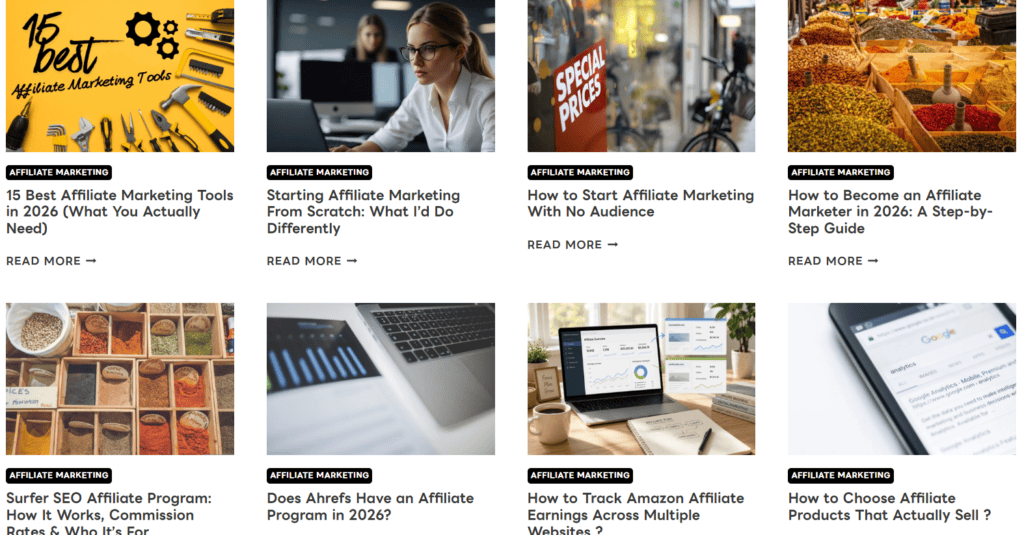
Affiliate Marketing Content Cluster
A Real Moment From Building This: When I first added affiliate links to a few early SmileGrows articles, I remember second-guessing almost every single one, wondering if it looked too salesy, if I was adding it in the wrong place, if a reader would feel like the article had switched from “helping you” to “selling to you” halfway through.
That discomfort didn’t fully go away. I just learned to use it as a check: if I felt uneasy about a link, that was usually a sign it didn’t belong there yet.
12. Don’t Make Money the First Question
This might sound strange in an article specifically about making money blogging, but I think it matters.
If your first question is “how quickly can I make a thousand dollars,” you can end up making poor decisions, choosing a niche you don’t actually understand, publishing shallow articles, stuffing in too many affiliate links, buying tools you don’t need, chasing trends that don’t fit your site, and giving up the moment traffic feels slow.
A better first question is: “what useful asset can I build that becomes more valuable over time?”
A good article can bring visitors for months or years. A useful email list compounds. A digital product can be improved and resold. A trusted brand gets stronger the longer it stays consistent.
That’s the kind of asset I’m actually trying to build with SmileGrows, and it’s a much steadier motivation than chasing a specific dollar figure by a specific date.
Final Thoughts
There isn’t one secret way to make money blogging, there are several real business models, and the important part is matching the model to your actual audience rather than copying whatever’s trending.
Start with useful content, learn what people genuinely need, build traffic, earn trust, and then introduce monetization naturally instead of forcing it in early.
If you’re leaning toward the affiliate route specifically, the next honest question worth asking is whether blogging is still a realistic way to make money at all in 2026, and what’s actually changed compared to the earlier blogging era.
[Can You Still Make Money Blogging in 2026?]
Because the truthful answer sits somewhere in the middle, nowhere near “blogging is dead,” and nowhere near “anyone can make ten thousand dollars a month” either.