How to choose a blog topic? What to Blog About When You Have Too Many Interests
Here’s a problem nobody really warns you about before you start a blog: having too many ideas can be just as paralyzing as having none.
You’re interested in money. But also productivity. And books. And maybe AI. And travel. And personal development. Then you stumble on something else interesting and think, “maybe I should write about that too.” Before long your blog has quietly become a little bit of everything, which, from a reader’s perspective, usually reads as a little bit of nothing in particular.
I’ve run into this exact problem while building websites and planning content. How to choose a blog topic? The hard part was never generating ideas. The hard part was choosing.
So if you have too many interests and no clear direction, here’s what’s actually helped me.
What I Actually Went Through: Before SmileGrows settled into a money-focused site, I genuinely considered a handful of other directions, at one point I had a half-built content plan mixing productivity tips with financial advice, and it took me embarrassingly long to admit the two audiences didn’t really overlap as much as I wanted them to. Letting go of the productivity angle felt like a loss at the time. In hindsight, it’s the thing that made the rest of the planning click into place.
1. Don’t Turn Your Blog Into Your Brain’s Filing Cabinet
Your personal interests don’t have to become your website’s categories, that’s an important distinction to make early.
You might personally enjoy:
- Finance
- History
- Books
- Psychology
- Entrepreneurship
- Travel
That doesn’t mean your website should have six unrelated categories.
Imagine visiting a website and seeing:
Make Money
Gardening
Bitcoin
Parenting
Recipes
Productivity
Travel
You might think: “What exactly is this website about?” That’s the problem.
A blog isn’t a complete map of your personality. It’s a product for a particular reader.
2. Choose the Reader First
Instead of asking “what do I want to write about,” ask “who do I actually want to help?” That single question changes everything downstream.
Let’s say you love:
- Money
- Books
- Psychology
- Productivity
Those topics can look unrelated.
But maybe your target reader is: Someone who wants to become more financially capable and make better decisions. Now you can naturally connect the subjects.
Books can become: Books that improve financial thinking.
Psychology becomes: The psychology behind spending.
Productivity becomes: How to manage time while building a side income.
Suddenly your interests aren’t competing. They’re supporting one central audience.
3. Find Your “Umbrella”
I like to think of this as finding the umbrella, the one big theme everything else can shelter under. For SmileGrows, the umbrella is simply money. Underneath it, I have room for making money, saving money, budgeting, money basics, financial thinking, and money mindset.
But the reader still understands what the site is about.

That structure gives me plenty of room to explore without the reader ever losing track of what the site is fundamentally about. That balance enough breadth to stay interesting, enough focus to stay recognizable is exactly what you’re looking for.
4. Use the “Same Reader” Test
Here’s a quick sanity check I use constantly. Take two potential article ideas, say, “how to start a side hustle” and “10 books that changed my life.” Would the same person genuinely want to read both?
If yes, there’s probably a real connection worth building on. If not, you’re likely looking at two different audiences pretending to be one blog.
This isn’t only an SEO problem. It’s an audience-building problem.
Someone who follows you for budgeting advice may not care at all about your travel photography, and someone who comes for gardening tips probably isn’t interested in your affiliate marketing tutorials. A focused audience is genuinely easier to build and easier to keep.
5. Create a “Parking Lot” for Ideas
This is one of the simplest things that’s actually helped me. Don’t delete extra ideas, park them. I keep a running document literally called “future blog ideas,” and whenever something interesting crosses my mind, it goes there instead of into this week’s content plan.
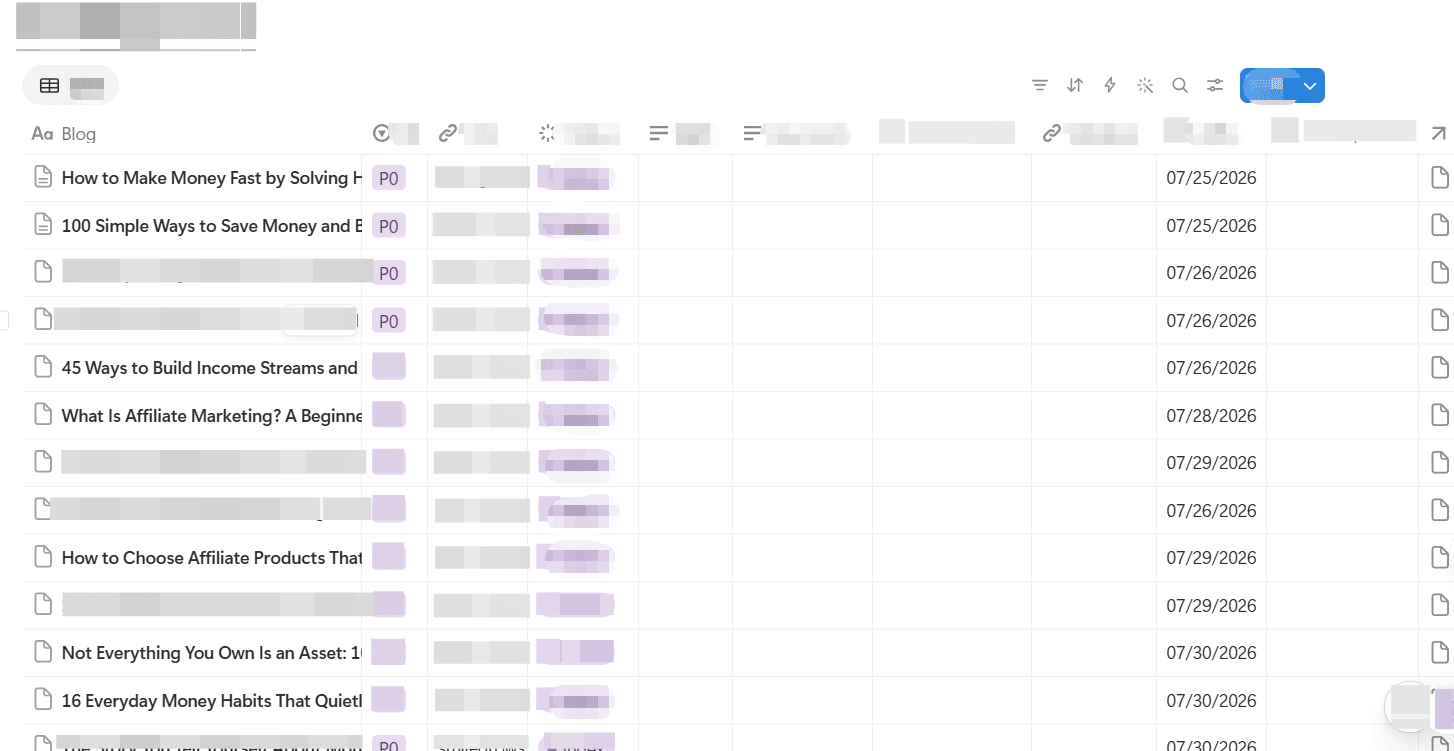
There’s something psychologically useful about this. You’re not telling yourself “I can never write about this.” You’re telling yourself “not yet.” That’s a much easier thing to accept than permanent rejection, and it keeps you from derailing a plan you’ve already committed to.
6. Don’t Let New Ideas Destroy Your Existing Plan
This happens constantly if you’re not careful.
You publish three solid articles about budgeting. Then you read something fascinating about blogging strategy and think, “maybe I should pivot to writing about blogging instead.” Two weeks later you discover a new AI tool and your site quietly turns into budgeting-plus-blogging-plus-AI-plus-whatever-else. This is exactly how a lot of promising new sites lose their momentum before they ever build any.
The fix is almost embarrassingly simple: finish the experiment you’re already running before starting a new one. Give a topic long enough to actually produce information before abandoning it for the next shiny idea.
7. Try the 80/20 Rule
You don’t necessarily have to kill every secondary interest. I’ve found it useful to aim for roughly eighty percent core topic and twenty percent related exploration.
If your blog is about money, that eighty percent might be budgeting, saving, making money, and financial education, while the twenty percent leaves room for books, psychology, productivity, or lifestyle content, as long as those pieces still connect back to your main audience rather than wandering off on their own.
A Small Confession: I still keep a folder of “someday” ideas that have nothing to do with money, a couple of them are genuinely good ideas for a completely different website. I haven’t touched them, and I probably won’t for a while. That’s not wasted creativity. It’s just creativity waiting for the right container.
8. When Should You Create a Second Website?
Sometimes your interests really are unrelated enough that one website can’t hold them both, “how to start a side hustle” and “my guide to growing tomatoes” aren’t going to share an audience no matter how you frame them. That’s fine.
But I wouldn’t recommend launching two sites on day one. One website is already plenty of work. Build it properly first, learn content, SEO, analytics, email, monetization, and basic site management, and then decide whether a second project genuinely makes sense.
9. Your First Blog Doesn’t Have to Represent Your Entire Life
This might be the point I’d most want a creative, curious person to hear. Choosing one niche doesn’t mean giving up every other interest you have. You can still read widely, learn economics, travel, study psychology, mess around with AI, or pick up photography.
Your blog doesn’t need to contain everything you’re interested in. Your personal life can stay as broad as you want, your business can stay focused. Those are two entirely different things, and mixing them up is where a lot of scattered blogs come from.

10. What I Did With SmileGrows
SmileGrows didn’t start with a polished, finished editorial strategy, it got clearer the more I actually worked on it.
Along the way I’ve learned I don’t need to publish every topic I personally find interesting. Instead, I ask one question before adding anything to the content plan: does this genuinely help the person I’m building SmileGrows for?
If yes, it goes on the list. If not, it goes to the parking lot. That one small filter has made planning noticeably easier, and it’s saved me from a handful of detours I would have regretted.
The One Question That Solves Most of This
If you’re still stuck, try this: if someone read five articles on your website, what would you want them to walk away believing your site is about?
If your honest answer is “I have no idea,” your niche probably needs more focus. If your answer is something like “it’s a site that helps ordinary people get better with money,” you’re already getting somewhere real, and from there, deciding what to write next gets a lot easier.
Once you’ve settled on a direction, the next real question isn’t “what else could I write about” — it’s “will anyone actually find it.” That’s a traffic problem, not a topic problem, and it deserves its own honest answer.
[How to Choose a Blog Niche: A Practical Guide for Beginners →]