How to Turn a Blog Into a Business: From Content to Income
If you’re wondering how to turn a blog into a business, the biggest mindset shift is this: stop thinking of the blog as the business. Think of it instead as the engine that helps build the business.
An article can attract a visitor. A genuinely good article can build trust. That visitor might join your email list. They might read a second article, then a third. They might click an affiliate recommendation. They might, eventually, buy something.
Multiply that by hundreds or thousands of small interactions over time, and you start to have something real. That’s the model I’m working toward with SmileGrows, not “write more blog posts” as a goal in itself, but content leading to audience, audience leading to trust, trust leading to an offer, and the offer leading to revenue and growth.
Let’s break that down piece by piece.

1. A Blog Is an Asset, Not Just an Activity
When you publish an article, you’re creating something that can keep working long after you’ve stopped actively thinking about it.
A genuinely useful piece can show up in search, answer real questions, bring in new visitors month after month, link out to other content on your site, introduce products naturally, build your authority on the topic, and collect email subscribers along the way. That’s a meaningfully different dynamic from most social media, where a post gets attention for a day and then effectively disappears into the feed.
A strong evergreen article can keep attracting people for months or years, which doesn’t mean every single article will rank forever, but it does mean the content genuinely has the potential to become an asset rather than a disposable update.
2. Build Your Audience Around a Problem, Not a Topic
Businesses don’t grow simply because they publish content. They grow because they solve a real problem for a specific group of people.
For SmileGrows, the broader problem I’m working on is how ordinary people can get better with money, which folds in earning more, saving more, budgeting, understanding money basics, and making better financial decisions overall. That gives the site an actual reason to exist beyond “here’s another money blog.”
Your own site needs something similar underneath it. Ask yourself directly what problem your website genuinely helps people solve.
The clearer that answer is, the easier every other decision becomes, what to publish next, who you’re actually writing for, which products might make sense to create, which affiliate programs are worth joining, and what you’d even say in an email to your list.
What I Had to Rework: Early on, I described SmileGrows to myself in vague terms like “a site about money stuff,” which sounds fine until you try to plan actual content around it. It wasn’t until I forced myself to write a single sentence describing the exact problem the site solves that planning got noticeably easier, everything either fit that sentence or it didn’t.
3. Think of Content as Your Top-of-Funnel
It helps to picture your blog as a funnel rather than a flat pile of articles.
At the very top sits search, social, or referral traffic. That leads into a blog article, which connects to related content, which can lead to an email signup, which eventually opens the door to a recommendation or product, which may lead to an actual purchase.
The article itself doesn’t have to make money immediately, its first job is often simply to attract the right person in the first place.
Someone searching “how to choose a blog niche” probably isn’t ready to buy anything at that moment, and that’s completely fine. You help them first. Then you introduce something related, like: [How to Do Keyword Research for a Blog: A Beginner-Friendly Guide]
Later, that same reader might come across: [How to Make Money Blogging: 7 Realistic Ways to Monetize a Blog]
and at that point they’ve moved considerably deeper into your ecosystem without you ever pushing them there directly.
4. Build Content Clusters Instead of Random, Disconnected Posts
This is one of the biggest lessons I’ve picked up while structuring SmileGrows. Random content makes a website genuinely harder to navigate, both for readers and for search engines trying to understand what your site is actually about. Clusters, on the other hand, create clear pathways.
The Blogging cluster moves from starting a blog, to understanding costs, to choosing a niche, to keyword research, to getting your first visitors, to how to make money blogging, to whether blogging is still worth it in 2026, and finally to this article on turning it into a business.
Meanwhile the Affiliate Marketing cluster moves from what affiliate marketing even is, to becoming an affiliate marketer, to starting with no audience, to choosing affiliate products, to affiliate networks, to affiliate tools, to specific affiliate programs. Each cluster gives readers somewhere obvious to go next, and gives you natural, honest opportunities for internal linking rather than forced ones.
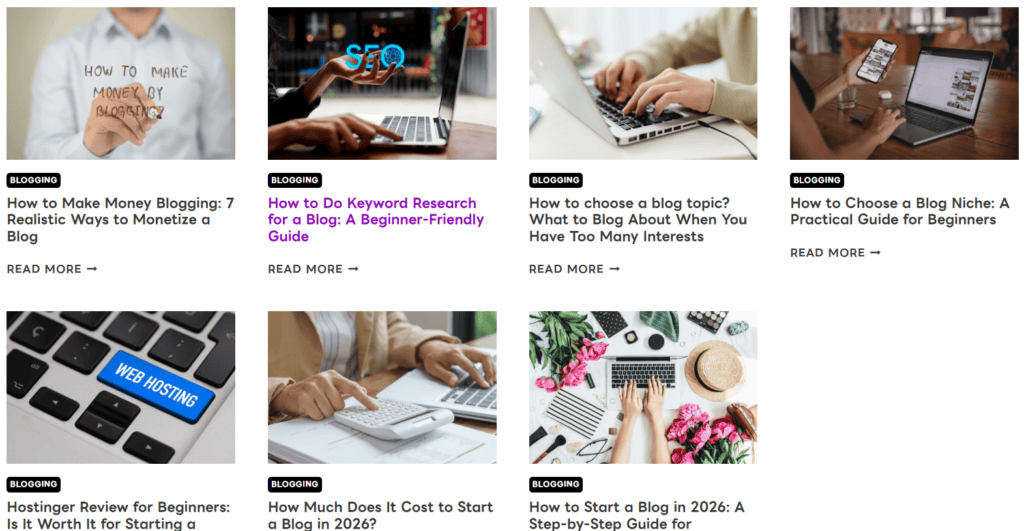
The smilegrows site features a cluster of blogs about writing blogs.
5. Choose Your First Monetization Model — Just One
You don’t need five revenue streams running simultaneously from day one. Choose one.
For a lot of bloggers, affiliate marketing is the natural starting point, because you can recommend existing products without having to build your own first. If your audience needs hosting, SEO tools, email software, design software, books, or general business tools, you may be able to recommend genuinely relevant products through affiliate programs already built for that purpose.
That’s exactly why SmileGrows has a substantial Affiliate Marketing section already in place. If you’re starting from zero, I’d begin with: [What Is Affiliate Marketing? A Beginner’s Guide to Building Passive Income Online]
then move into: [How to Choose Affiliate Products That Actually Sell ?]
and: [How to Choose the Right Platform for Your Affiliate Marketing Journey ?]
6. Don’t Turn the Blog Into a Sales Catalog
This is where a lot of content businesses quietly go wrong. They discover affiliate marketing works, and gradually every article turns into “buy this,” “click this,” “try this,” “subscribe here.”
Eventually the whole website starts to feel like a shopping mall dressed up as a blog. That’s genuinely not what I want SmileGrows to become. The content needs to stay useful even for a reader who never buys a single thing, that’s the standard I’m holding myself to. Education first, promotion second, in that order every time.
That principle also happens to be reflected directly in SmileGrows’ stated editorial approach, which emphasizes accuracy, education over promotion, transparency, and practical advice over unrealistic promises.
7. Build an Email List Alongside Everything Else
If you’re serious about turning a blog into a business, don’t sideline email.
Search traffic is genuinely valuable, but you don’t own Google. Social traffic is valuable too, but you don’t own those platforms either — either one can shift under you with an algorithm update you have zero control over.
Your email list is fundamentally different, because someone has voluntarily said “I want to hear from you again.” That relationship can eventually carry new articles, practical tips, personal lessons, curated resources, product recommendations, new launches, and special offers. The goal was never to email people daily, it’s to stay useful enough that they genuinely want to keep hearing from you.
8. Eventually, Create Something You Actually Own
Affiliate income is genuinely useful, but at some point I’d seriously consider creating your own product. The reason is control, you control the product itself, the pricing, the positioning, the customer experience, and the branding around all of it.
A budgeting blog might eventually sell budget templates. A career blog might sell resume templates. A productivity blog might sell planning systems. A finance education site might sell proper educational guides.
Your existing content can help you figure out which product actually makes sense, if people keep asking the same question over and over, that’s a signal worth paying attention to, not ignoring.
9. Use Your Own Content as Market Research
This might be one of my favorite parts of the whole process. Imagine you’ve published fifty articles. Article A gets almost no traffic. Article B gets moderate traffic. Article C gets a genuinely surprising amount of traffic relative to the others. That last one is telling you something real, maybe readers care about that specific problem far more than you originally expected.
From there you can update the article, write related pieces around the same theme, build an email sequence about it, create a product tied to it, or look for relevant affiliate offers that match. Your audience is, in effect, helping you decide where to invest your limited time. That’s a genuinely useful position to be in.
10. Build Multiple Revenue Streams — Slowly, One at a Time
Once one model is actually working, you can layer in another.
A common progression looks like affiliate marketing first, an email audience second, a digital product third, advertising fourth, and sponsorships or services fifth. You don’t need all of them, and you certainly don’t need them simultaneously.
The real point is diversification over time, if your entire business depends on one traffic source or one affiliate program, you’re carrying a level of concentration risk that can hurt badly if that single thing changes.
11. Don’t Confuse Revenue With Profit
This is a business lesson worth internalizing early.
If your blog earns a thousand dollars in a month, that doesn’t mean you made a thousand dollars. There’s hosting costs, software subscriptions, email platform fees, any advertising spend, freelancer payments, design tools, taxes, and payment processing fees sitting somewhere in the background.
Revenue is what comes in. Profit is what’s actually left after all of that.
As your blog grows, it’s worth starting to think like a business owner tracking real numbers rather than just watching pageviews climb and assuming that translates directly into income.
12. Track the Numbers That Actually Matter
You don’t need an elaborate dashboard to do this well. A handful of numbers goes a long way: how much relevant traffic you’re getting, whether your owned email audience is actually growing, whether people are engaging with your affiliate recommendations at all, whether those clicks turn into real conversions, how much revenue the whole thing generates, and — the one people skip — how much profit actually remains after expenses.
Over time, these numbers quietly tell you where the real opportunities in your specific business are hiding.
13. Your Blog Can Become Bigger Than the Blog
This is the long-term version of the vision. It starts with one article, then grows to a hundred articles, then an email list, then affiliate revenue, then your own product, then eventually a recognizable brand built around all of it.
The original blog is still there underneath everything, it’s just become the foundation for something considerably larger than itself. That’s the real difference between saying “I have a blog” and saying “I have an online business that happens to use a blog as one of its main growth engines.”
14. What I’m Actually Building With SmileGrows
This is exactly why I’m taking the underlying structure of SmileGrows seriously instead of just publishing more posts for the sake of a bigger number. I’m building connected systems, not a pile of unrelated content.
The Blogging cluster teaches readers how to actually build a blog. The Affiliate Marketing cluster teaches them how that specific monetization model works. The two connect naturally into each other, and eventually the broader Make Money section can extend that same logic into side hustles, other forms of online income, digital products, and additional business ideas.
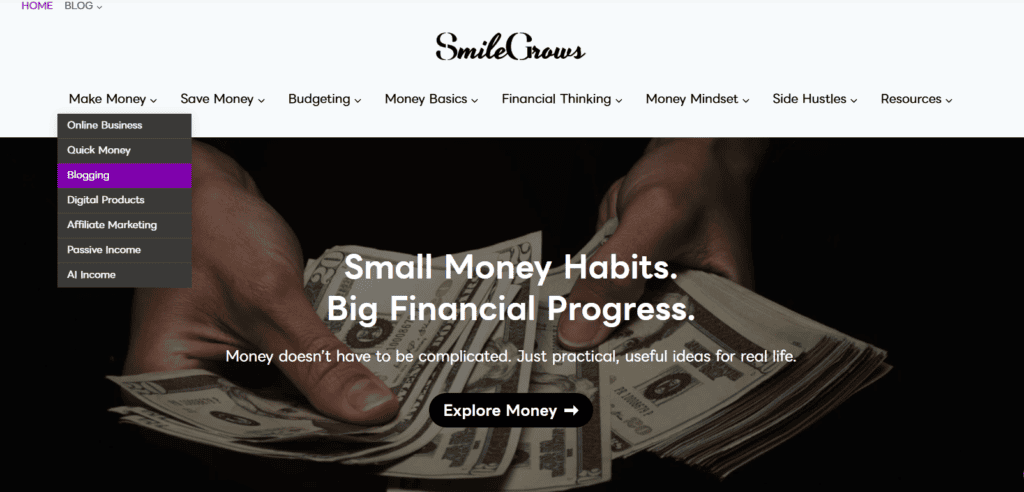
The SmileGrows Make Money category
The underlying idea is simple: one genuinely useful article should lead naturally into another useful article. Eventually, some of those readers become subscribers, customers, or users of whatever I end up recommending or building.
15. The Business Doesn’t Start When You Make Your First Dollar
This is a mindset shift worth sitting with. Your first affiliate commission feels exciting. Your first product sale feels exciting too. But neither of those moments is actually the beginning of the business.
The business begins the moment you start building a repeatable system, one where you can consistently create useful content, attract the right readers, build genuine trust, get people to come back, grow an email list, recommend relevant products honestly, eventually create things people actually want, measure what’s actually working, and keep improving the whole loop based on real data instead of guesses.
If you can do that consistently, you’ve stopped simply writing blog posts. You’re running a business, even if it still looks small from the outside.
Final Thoughts
If you’re genuinely asking how to turn a blog into a business, don’t start with “what can I sell?” Start with “who am I helping, and what specific problem am I solving for them?”
Then build outward from that answer, create useful content, build search traffic, connect your articles into something coherent, start an email list, choose one monetization model to begin with, recommend products you’d actually stand behind, and eventually create something of your own once you understand your audience well enough to do that responsibly.
Then keep improving all of it.
That’s the path I’m taking with SmileGrows. I genuinely don’t know exactly what the site will look like three years from now, and I don’t think I need to know that right now.
I just need to keep building the next useful piece. A business isn’t created by one perfect article, it’s created by hundreds of ordinary, useful decisions made consistently over time. And that’s exactly where the real opportunity in blogging still lives, even in 2026.
[How to Make Money Blogging: 7 Realistic Ways to Monetize a Blog]
[Can You Still Make Money Blogging in 2026?]
[How to Become an Affiliate Marketer in 2026: A Step-by-Step Guide]