How to Get Your First 100 Blog Visitors
There’s a strange moment almost every new blogger goes through. You finally hit publish on your first article. The site looks good. You refresh Google Analytics.
Zero visitors.
You wait a bit, refresh again. Still zero. You publish a second article. Maybe now there’s one visitor, and you start quietly wondering if anyone will ever actually care about this thing you just built.
Don’t panic, a brand-new website having no audience is completely normal, not a sign that something’s broken. The goal at this stage isn’t 100,000 monthly visitors. It’s something much smaller and far more achievable: your first 100 real visitors.
Those hundred people can teach you more than a thousand random, disengaged views ever will. But how to get your first 100 blog visitors?
What I Actually Felt: I remember checking Search Console for SmileGrows more times a day than I’d like to admit in the first few weeks, half hoping the number would suddenly jump.
It didn’t. What actually happened was slower and less dramatic, a trickle of single-digit visits that only started to look like something real after I stopped refreshing constantly and just kept publishing.
1. Where Your First Visitors Actually Come From
Early traffic tends to come from a handful of places: Google, Pinterest, Reddit, Facebook, X, email, personal networks, relevant communities, and direct traffic from people you’ve told about the site yourself.
You don’t need to be active on all of them.
In fact, trying to promote everywhere at once is its own quiet form of procrastination, it feels productive without actually building anything. Pick a few channels you can realistically keep up with and go deep instead of wide.
2. Start With Search-Friendly Content
If you’re building for the long term, SEO belongs in your strategy from day one, not as an obsession over rankings, but as a habit of asking “what is someone actually searching for?”
A title like “My Thoughts on Starting a Website” is vague. “How to Start a Blog in 2026” tells a searcher exactly what they’re getting before they even click. That clarity is most of what keyword research is really about.
[How to Do Keyword Research for a New Blog →]
3. Don’t Just Sit Around Waiting for Google
A common beginner mistake is publishing an article and assuming Google will eventually send traffic on its own.
Eventually, it might. But a brand-new site has no established visibility yet, so while you’re waiting for organic search to develop, you can actively put your work in front of people yourself, sharing useful articles on social platforms, showing up in relevant communities, answering questions where your article genuinely helps, building Pinterest content if it suits your niche, or starting an email list.
The key word there is genuinely. Don’t join a community and immediately start dropping links everywhere. People notice that instantly, and it tends to backfire.
I’ll admit this is the part I find least natural. Writing an article is comfortable for me. Showing up in a forum or a Facebook group and actually being useful to strangers, without immediately mentioning my own site, took more discipline than I expected.
But it’s also the part that made the difference between articles that sat quietly and articles that actually got read by real people.
4. Solve the Problem Before You Promote Yourself
Imagine someone asks, “how much money do I need to start a blog?” and you reply, “check out my website!” That’s not actually helpful, it’s just self-promotion wearing a helpful costume.
Give them a real, useful answer first. Then, if you happen to have a more detailed breakdown, you can mention it naturally: “I actually wrote a longer breakdown of the costs here, if you want the full picture.” That’s not interrupting the conversation. That’s extending it.
5. Treat Your First 100 Visitors as Research, Not a Scoreboard
This is something I think new bloggers underrate.
Don’t just watch the traffic number climb, watch what those visitors actually do. Which article brought them in? Where did they come from? How long did they stay? Did they read a second article? Did they click anything, subscribe, or come back later?
One article bringing thirty genuinely interested readers can be far more valuable than another bringing three hundred people who bounce immediately.
Traffic quality matters more than the raw count, especially this early.
6. Build Internal Links From the Very Beginning
Suppose someone lands on “How to Start a Blog” and finishes reading it. What happens next?
You need to give them somewhere useful to go, from that article toward the cost breakdown, then the hosting review, then niche selection, then keyword research, and so on. That’s exactly why I’m building SmileGrows as connected clusters instead of a pile of unrelated posts.

One visitor reading one article can turn into two pageviews, then three, and eventually an email subscriber or a reader who discovers a product you recommend. None of that happens if every article is a dead end.
7. Publish More Than One Article
A single article rarely gives you enough signal to learn anything. Publishing “How to Start a Blog” and waiting six months is basically buying one lottery ticket and hoping.
Building a small cluster instead, start a blog, cost breakdown, hosting review, niche selection, narrowing down ideas, first 100 visitors, keyword research, gives your site actual depth, and each piece can support the others instead of standing alone.
8. Hold Off on Paid Traffic
If your site is brand new, I’d be cautious about spending money on ads just yet.
You don’t know enough yet, which content actually converts, which audience responds, which pages retain visitors, or which offers work. It’s easy to end up paying to send people to a page that isn’t ready for them. Learn how organic visitors behave first. Experiment with paid traffic once you actually have something to learn from.
9. Growth Won’t Come All at Once
Your early traffic might look something like seven visitors in week one, twelve in week two, eighteen in week three, and thirty in week four, and then, somewhat unpredictably, one article starts picking up impressions, then another.
Growth at this stage is rarely a straight line, which is exactly why blogging can feel discouraging early on. You put in weeks of work and don’t see much movement. Then, without much warning, something starts to shift.
A Small Detail Worth Mentioning: Not every article performs equally, and that’s fine.
A couple of my early posts genuinely flopped, barely any views, no engagement, nothing to learn from except “maybe this specific angle wasn’t it.” I didn’t delete them or panic about it.
I just noted which ones worked better and leaned into that pattern for the next round of topics.
10. What I’m Actually Doing With SmileGrows
I’m building SmileGrows around connected content clusters instead of chasing every possible traffic source at once. For the Blogging category specifically, the articles move from starting a blog, to choosing a niche, to creating content, to getting traffic, to SEO, to monetization, giving readers an actual path to follow, and giving Google a clearer sense of what the site covers overall.
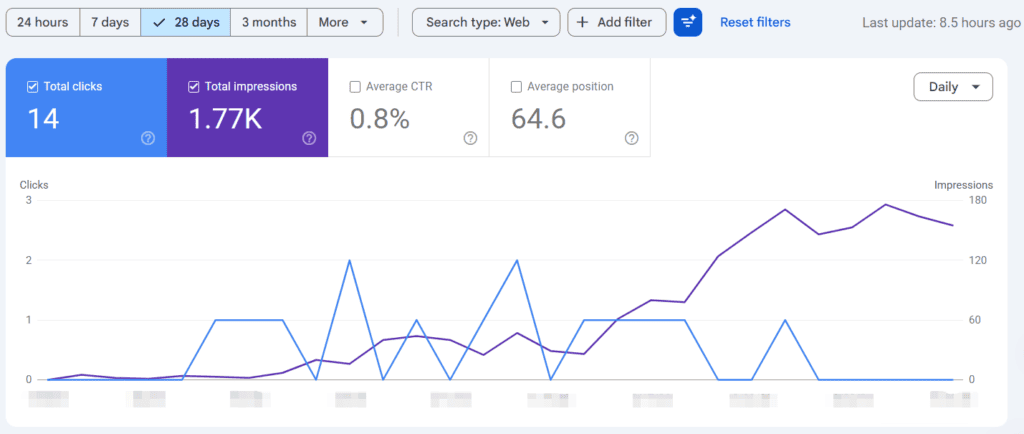
Early data from the smilegrows site
I’m also being upfront about the numbers as part of the content itself. If traffic is small, I’ll say it’s small. If something doesn’t work, I’ll say that too, because building a blog is genuinely a process, not a highlight reel.
11. A Simple First-100 Strategy
If I were starting from zero again, here’s the order I’d follow: ① publish useful content consistently instead of one article and disappearing, ② build internal links so readers always have somewhere to go next, ③ start basic SEO by understanding search intent and keywords, ④ share selectively in the places your actual audience spends time, ⑤ track what happens with analytics, and then improve, ⑤ updating weak articles and expanding whatever shows early promise.
Then repeat the whole cycle.
12. Your First 100 Matter More Than They Look Like They Do
Your first 100 visitors aren’t just a number ticking upward. They’re proof that someone, somewhere, decided your content might be worth their time. Your job from there is to make sure they were right.
Don’t chase 10,000 visitors before you’ve figured out how to genuinely help the first 100. Once you understand that, 1,000 stops feeling mysterious, and at some point you may notice the blog isn’t just a collection of articles anymore. It’s starting to look like an asset.
[How to Make Money Blogging: 7 Ways to Monetize Your Blog →]