Can You Still Make Money Blogging in 2026?
If you’re wondering whether you can still make money blogging in 2026, you’re asking a completely reasonable question.
The internet looks nothing like it did in the early blogging days. AI can generate an article in seconds. Social media has swallowed a huge share of people’s attention. Google’s results keep shifting. People consume more video than ever. And competition for popular topics can feel genuinely intense.
So is blogging still worth starting? I think it can be, but I don’t think the old version of blogging is the opportunity anymore. The days of publishing three-hundred-word articles, stuffing keywords into every paragraph, and waiting for Google to magically send traffic are long gone.
What’s replaced it is different, and honestly a bit more demanding, but it’s not gone.

1. Blogging Isn’t Dead. The Easy Version Is.
This distinction matters more than it sounds.
When people say “blogging is dead,” what they usually mean is that the old low-effort model doesn’t work as easily anymore. That’s very different from the activity itself disappearing. People still search for information. They still compare products before buying. They still read tutorials before attempting something new. They still look for answers to specific problems, and businesses still need content to reach them.
The underlying behavior hasn’t gone anywhere, the environment around it has simply gotten more competitive, which means the bar for “useful” has quietly risen.
2. AI Changed the Game — Just Not the Way Most People Think
AI is probably the single biggest shift new bloggers need to understand. Anyone can now generate article outlines, full drafts, headlines, meta descriptions, social posts, images, and research summaries far faster than before.
That creates an interesting problem: if everyone can produce more content, content itself becomes less scarce. So what actually becomes valuable in that environment? Experience. Judgment. Original research. Real examples. Actual testing. Screenshots from something you genuinely did. Clear explanations. A distinct point of view. Human stories that an AI simply can’t fabricate convincingly.
That’s exactly why I’ve deliberately woven my own experience into building SmileGrows. When I write “here’s what I actually did,” that’s more useful to a reader than pretending I’ve discovered some secret formula nobody else has access to.
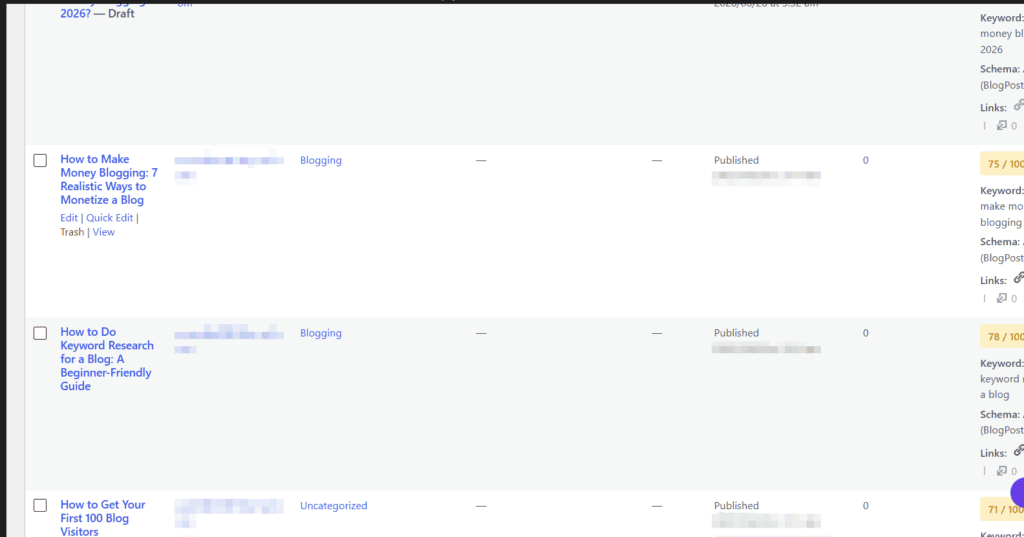
Something I’ve Noticed: The articles on SmileGrows that get the most engagement aren’t necessarily the most polished ones, they’re the ones where I admitted something didn’t go smoothly, or showed an actual screenshot of a messy first attempt instead of a clean final result.
Readers seem to trust that more than they trust perfection, which honestly surprised me the first few times I noticed the pattern.
3. Search Traffic Still Matters — It Just Works Differently Now
SEO isn’t dead either, but it’s changed shape. You shouldn’t think of it as keyword leads to article leads to ranking leads to money, as if it’s some automatic pipeline.
A more accurate model is search intent leading to a genuinely useful answer, which builds trust, which leads to a next action. Someone searching “how much does it cost to start a blog” wants an actual answer. If your article answers it clearly, gives real numbers or examples, and helps them decide what to do next, you’ve created real value regardless of what algorithm changes happen around you.
That’s why the Blogging content on SmileGrows is structured as a connected journey instead of a pile of disconnected keyword targets.
[How to Start a Blog in 2026: A Step-by-Step Guide for Beginners]
leads naturally into: [How Much Does It Cost to Start a Blog in 2026?]
which can lead into: [Hostinger Review for Beginners: Is It Worth It for Starting a Blog?]
and from there into niche selection, traffic, SEO, and monetization content that all connects back to itself.
4. You Don’t Need Millions of Visitors
This is one of the more persistent misconceptions out there. You don’t need a massive audience for a blog to matter financially.
Imagine a site pulling in 3,000 people a month, if those 3,000 are exactly the right audience, that can be genuinely meaningful.
A site about “best tools for freelance designers” might have a relatively small readership overall, but some of those visitors are actively shopping for expensive software right now. That’s a completely different situation from a site pulling in millions of casual entertainment views that never convert into anything.
When I think about blogging income, the questions I actually care about are who is visiting, why they came, what problem they’re trying to solve, and what happens after they finish reading. Those four questions matter more than the visitor count on their own.
5. Affiliate Marketing Is Still Relevant
Affiliate marketing remains one of the most natural ways to monetize content because it connects information directly to a purchase decision that’s already happening.
Someone searching “best email marketing software for beginners” is already thinking about buying something, a useful comparison article can genuinely help them decide, and if it contains affiliate links, you may earn a commission when they do.
That’s a fundamentally different situation from randomly inserting an unrelated product into an article that has nothing to do with it.
This is exactly why SmileGrows has a dedicated Affiliate Marketing section. If the model interests you, I’d start with: [What Is Affiliate Marketing? A Beginner’s Guide to Building Passive Income Online]
then: [How to Become an Affiliate Marketer in 2026: A Step-by-Step Guide]
and if you don’t have an audience yet: [How to Start Affiliate Marketing With No Audience]
6. Your Own Products May Be Even More Valuable Now
Here’s something I think is genuinely easy to overlook: a blog doesn’t have to depend entirely on Google to survive. Once you build even a modest audience, you can eventually create your own products, a digital guide, a template, a spreadsheet, a course, a membership, a small tool, a newsletter, or a coaching offer.
The economics look very different from advertising, because you’re not simply selling attention to a third party, you’re creating something people can directly buy from you, and your existing content can help you figure out exactly what that product should be.
7. The Biggest Opportunity Right Now May Be Trust
Think honestly about the internet today. There’s more information available than at any point in history, and that abundance hasn’t made people more trusting, if anything, it’s made them more skeptical.
When I read a product review, I want to know if this person actually used the thing. When I read a tutorial, I want to know if they actually did it themselves. When someone recommends a tool, I want to know why, specifically, beyond “it’s the best.”
That’s why I think personal experience has become more valuable, not less, in an AI-saturated content landscape. You don’t need to pretend you’re an expert at everything under the sun. Sometimes “I’m testing this right now, and here’s what’s happened so far” is far more credible than a confident-sounding summary with no real experience behind it.
That’s the approach I’m taking with SmileGrows, even when it means admitting something is still a work in progress.
8. What Doesn’t Work as Well Anymore
I’d be genuinely cautious about a handful of strategies. Publishing hundreds of generic AI-written articles doesn’t automatically create value just because the count goes up. Chasing every trending keyword produces traffic without relevance, which isn’t really a business.
Copying competitors’ structure might get you close in format, but gives readers no real reason to remember your site specifically. Adding affiliate links everywhere is noticeable, and readers do notice it. Buying every SEO tool on the market doesn’t replace an actual strategy. And expecting immediate income is probably the single biggest mistake beginners make.
A new blog needs real time to build content, authority, traffic, and trust before any of it compounds into something financial.
9. What I’d Actually Do If I Started a Blog in 2026
I’d keep it simple.
Choose a clear audience, not “everyone interested in money,” but a specific kind of reader with a specific problem. Build a website that’s fast, simple, and easy to navigate rather than visually elaborate.
Create topic clusters instead of random, disconnected articles. Learn to think in terms of search intent, not just keywords. Add original experience wherever you genuinely have it. Build an email list so you’re not entirely dependent on search traffic.
Monetize naturally, starting with whichever model actually fits your specific audience. And keep improving based on what real visitors show you through their behavior, not based on guesswork.
10. How Long Does It Actually Take?
There’s no honest universal answer to this, and I’d be skeptical of anyone who gives you one with confidence. Some sites gain traction relatively quickly. Others take much longer, depending on the topic, the level of competition, content quality, actual search demand, accumulated authority, publishing consistency, promotion effort, and the specific monetization model chosen.
Anyone promising “start a blog and make five thousand dollars in ninety days” is selling certainty that simply doesn’t exist in this business. I’d rather build something with a real chance of still being useful three years from now than chase a number with an arbitrary deadline attached to it.
11. What I’m Actually Learning While Building SmileGrows
Part of why I’m documenting this process openly is that I don’t want SmileGrows to look like it appeared overnight with some perfect, fully-formed strategy.
It didn’t. I’ve changed categories along the way. I’ve reprioritized content more than once. I’ve gone back and researched keywords I initially skipped. I’ve rewritten pages that weren’t performing. I’ve built out content clusters gradually instead of all at once. I’ve tested different monetization ideas, some of which I’ve since dropped.
And I’m still learning, week to week. That’s normal, building a website isn’t a single decision you make once. It’s a long series of smaller decisions, most of them adjusted after the fact based on what actually happens.
12. So, Is Blogging Worth It in 2026?
My honest answer is yes, but only if you think beyond simply “writing articles.” A blog can become a traffic asset, a personal brand, an email audience, an affiliate business, a product business, a service business, or the foundation of something considerably larger.
The article itself is only the front door. What you build behind that door is what actually determines whether any of this becomes worth your time.
Final Thoughts
I wouldn’t start a blog in 2026 because someone online told me it was an easy path to passive income, because it isn’t, and pretending otherwise sets you up to quit the first time it gets hard.
I’d start one because I have something genuinely useful to build, something I can keep improving, something capable of attracting people through search over time, and something that can eventually support products, recommendations, services, or other income streams as it grows.
That’s the mindset I’m bringing to SmileGrows. Not “how quickly can I make money,” but “what useful asset can I build that becomes more valuable over time.” And if you’re ready to move past simply having a blog and start actually building a business around it, that’s the next question genuinely worth exploring.
[How to Turn a Blog Into a Business: From Content to Income]